
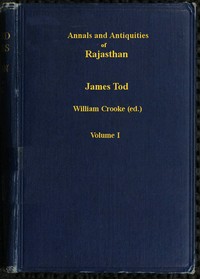
Annals and Antiquities of Rajasthan, v. 1 of 3 by James Tod
Let's be clear from the start: this isn't a novel. James Tod's 'Annals and Antiquities of Rajasthan' is a monumental, messy, and utterly fascinating record. Published in the 1820s, it's the result of Tod's years living in western India as a political agent for the British East India Company. His official job involved diplomacy, but his real passion became documenting everything he saw and heard.
The Story
There isn't a single plot. Instead, Tod acts as your guide through the history of the Rajput clans—the warrior rulers of Rajasthan. He starts by describing the land itself: the harsh Thar Desert, the formidable forts. Then, he dives into lineage after lineage, telling their stories. You'll read about kings who chose death before dishonor, legendary battles against overwhelming odds, and intricate codes of honor that governed everything. He copies inscriptions from crumbling walls, translates epic poems, and records local legends. The 'conflict' is the slow, painful subjugation of these proud, independent kingdoms, first by the Mughal Empire and then by the expanding British influence that Tod himself represented. The book is his attempt to make sense of it all, to preserve a culture he saw as noble and doomed.
Why You Should Read It
You read this for the atmosphere and the unique perspective. Tod is a contradictory figure—a colonial officer who often admires the people he's helping to administer. His writing is packed with vivid details: the heat of the desert, the chaos of a royal procession, the quiet of an abandoned temple. You get the sense of a man genuinely trying to bridge two worlds. Yes, his views are firmly 19th-century British, and that's important to remember. But that's also what makes it compelling. You're not getting a sanitized modern history; you're getting the raw, unfiltered observations of a man who was there, confused, impressed, and sometimes horrified by what he found. The stories themselves, of sacrifice, love, and war, are simply unforgettable.
Final Verdict
This book is perfect for patient readers who love immersive history and don't mind a book that meanders like a long conversation. It's for anyone interested in India, colonialism, or how history gets written. It's not a quick or easy read—it's dense and detailed—but it rewards you with a one-of-a-kind portal into a lost time. Think of it less as a textbook and more as a giant, overflowing scrapbook kept by a fascinating, flawed, and passionate man.
This publication is available for unrestricted use. Use this text in your own projects freely.
Ava Ramirez
9 months agoI came across this while browsing and the character development leaves a lasting impact. Exceeded all my expectations.
David Miller
7 months agoGreat read!
Emma Wright
1 year agoClear and concise.
Donald Allen
1 year agoVery helpful, thanks.
Linda Wright
2 years agoEnjoyed every page.