
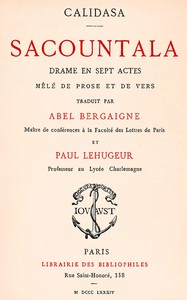
Sacountala, drame en sept actes, mêlé de prose et de vers by Kālidāsa
Have you ever picked up a book knowing it's ancient and expecting something distant, only to be completely swept up in the story? That was my experience with Kālidāsa's Shakuntala. Written in India around the 4th or 5th century, this play feels timeless in the best way.
The Story
King Dushyanta, while hunting, finds the peaceful forest hermitage of sage Kanva. There, he meets Shakuntala, the sage's adopted daughter, who was raised among nature and is utterly captivating. Their attraction is immediate and deep. They marry in a simple, private ceremony. Before returning to his royal duties, Dushyanta gives Shakuntala his signet ring as a pledge of his love, promising to send for her.
But a curse interferes. A short-tempered sage, offended by Shakuntala's lovesick distraction, declares that the person she is thinking of will forget her. The only cure? Showing him a token of their love. You can guess what happens next. Shakuntala, pregnant with the king's child, travels to his court. Without the ring (it slipped off her finger into a river), Dushyanta has no memory of her. He rejects her publicly in a devastating scene. The rest of the play asks: can this wrong ever be righted? Can love be recovered once it's been lost to a curse?
Why You Should Read It
This isn't just a plot about amnesia. It's about the tension between duty and desire, the natural world and the civilized court, and the power of fate. Shakuntala's quiet strength when faced with public humiliation is incredible. Kālidāsa's writing (even in translation) is lush and vivid. He paints the forest as a living, breathing character—a place of truth and purity contrasted with the formality of the palace. The mix of poetry and prose gives it a wonderful rhythm. You feel the heat of the king's passion in the verses and the painful reality of his forgotten promise in the dialogue.
Final Verdict
Perfect for anyone who loves a classic love story but wants to explore one outside the usual Western canon. If you enjoyed the mythical feel of Greek epics or the dramatic tension of Shakespeare, you'll find a kindred spirit in Kālidāsa. It's also a great pick for readers curious about ancient world literature—it's accessible, emotionally engaging, and relatively short. Don't let the date or the Sanskrit origin scare you off. This is a play about human hearts, and those haven't changed much in 1,500 years.
This historical work is free of copyright protections. You do not need permission to reproduce this work.
Steven Lopez
5 months agoI was skeptical at first, but it provides a comprehensive overview perfect for everyone. I learned so much from this.
Jackson Jones
8 months agoFinally a version with clear text and no errors.
Patricia Johnson
1 year agoSimply put, it provides a comprehensive overview perfect for everyone. I couldn't put it down.
David Davis
1 year agoWow.







Lisa Thompson
7 months agoA must-have for anyone studying this subject.