
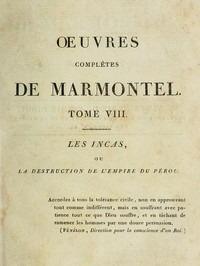
Œuvres complètes de Marmontel, tome 8 by Jean-François Marmontel
Diving into an 18th-century French author's complete works might sound like homework, but Jean-François Marmontel's eighth volume is anything but. This isn't a novel; it's a collection of his shorter prose, primarily his famous Contes Moraux (Moral Tales). These are snapshot stories of French society before the Revolution.
The Story
There's no single narrative. Instead, you get a series of self-contained tales. Picture elegant drawing rooms, country estates, and bustling Parisian salons. In one story, a well-meaning lie about a painting spirals into a crisis of reputation. In another, a young man must navigate the treacherous waters of love and honor, where a single misspoken word can demand a duel. The characters are types you'd recognize: the vain nobleman, the clever ingénue, the wise old tutor, the ambitious social climber. Marmontel puts them in delicate social situations—a misunderstood gesture, a secret letter, a clash of egos—and lets the drama unfold. The plots often hinge on a question of ethics or manners, asking whether being 'good' is the same as being 'polite.'
Why You Should Read It
I loved this because it feels so human. Strip away the wigs and the formal bows, and these people are dealing with the same stuff we do: fear of embarrassment, the desire for respect, the struggle to be authentic in a world with strict rules. Marmontel has a light touch. He's not preaching; he's observing with a smile. His wit is sharp but never cruel. You root for the characters who show genuine heart over empty ceremony. Reading these tales is like listening to brilliant, gossipy conversation from 250 years ago. It’s fascinating to see what they valued, what they laughed at, and what made them blush.
Final Verdict
This is for the curious reader who loves historical fiction but wants to go straight to the source. It's perfect for fans of authors like Jane Austen or Henry Fielding who want to explore the French literary salon scene that influenced them. It's also great if you enjoy short stories with a philosophical punch. A word of caution: it's a product of its time, so some perspectives will feel dated. But if you approach it as a window into a fascinating, complex world—one that was about to be turned upside down by revolution—you'll find it incredibly rewarding. Keep a dictionary handy for the occasional archaic term, but don't let that stop you. The emotions are perfectly clear.
This historical work is free of copyright protections. Share knowledge freely with the world.
Amanda Flores
3 months agoThis is one of those stories where the plot twists are genuinely surprising. Don't hesitate to start reading.
John Williams
8 months agoI didn't expect much, but the narrative structure is incredibly compelling. Truly inspiring.
Donna Jones
1 year agoI stumbled upon this title and the arguments are well-supported by credible references. Exceeded all my expectations.
Michael Jones
1 year agoGood quality content.
Charles Perez
8 months agoVery helpful, thanks.