
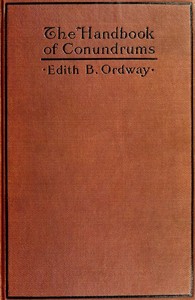
The Handbook of Conundrums by Edith B. Ordway
Let's clear something up right away: this isn't a novel. Published in 1914, The Handbook of Conundrums is exactly what the title promises—a massive collection of riddles, puzzles, and brain teasers compiled by Edith B. Ordway. Think of it as the ultimate party game book for the pre-internet, pre-television era. It’s organized into categories like ‘Charades,’ ‘Enigmas,’ ‘Arithmetical Problems,’ and ‘Puzzles in Verse,’ offering hundreds of ways to stump your friends at a parlor social.
The Story
There's no plot in the traditional sense. The ‘story’ is the journey of your own mind as you work through the puzzles. One minute you're deciphering a clever play on words about love and courtship, the next you're trying to figure out a logic problem about dividing money or a riddle based on common household objects. The book assumes a shared cultural knowledge—references to gas lamps, horse-drawn carriages, and social etiquette of the time are woven right into the puzzles. Reading it is less about finding a narrative and more about engaging in a silent, century-old game with its original author.
Why You Should Read It
I loved this book for the peek it offers into a forgotten form of entertainment. It’s social history disguised as fun. The puzzles reveal what people valued (cleverness, wordplay), what they found humorous, and even their common anxieties. Some conundrums about marriage or business feel timeless; others are charmingly dated. It’s also a great reminder that the human desire to solve, to outsmart, and to play with language is nothing new. You can dip in for five minutes and try a few, and it’s genuinely satisfying to solve one that someone might have puzzled over in 1914.
Final Verdict
This book is a niche gem, but a brilliant one. It’s perfect for history buffs who enjoy social history from the ground up, lovers of word games and riddles, and anyone with a curiosity about how people spent their leisure time a hundred years ago. It’s not a page-turning thriller, but it is a fascinating and interactive artifact. Keep it on your coffee table or in your bathroom for short, engaging mental stretches. Just be warned: some answers might leave you scratching your head, proving that humor and logic can be very much of their time.
This title is part of the public domain archive. Distribute this work to help spread literacy.
Richard Lopez
4 months agoThis book was worth my time since it challenges the reader's perspective in an intellectual way. I learned so much from this.
Barbara King
1 year agoNot bad at all.
Lisa Allen
10 months agoMy professor recommended this, and I see why.
Brian Jones
1 year agoI started reading out of curiosity and the storytelling feels authentic and emotionally grounded. Exceeded all my expectations.
Kevin Robinson
1 year agoThis book was worth my time since it creates a vivid world that you simply do not want to leave. Don't hesitate to start reading.