About 53 minutes
The Kink — Story, Setting & Ideas
Adventure Picaresque Fiction
12,068 recorded words. 17 minutes difference from this book's estimate.
View Gutenberg source #73536
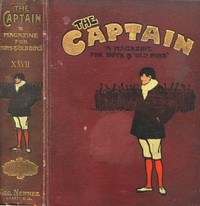
The source record for Three short stories from "The Captain" volume XXVII How Dymock Came to Derry; Jack Devereux's Scoop; The Powder Hulk — Key Ideas to Explore measures this digital text at 16,084 words, 1 hr 10 min estimated reading time, and 2 detected text sections.
The text analysis averages about 17.5 words per sentence, while the detected sections provide another way to judge how the source is divided.
Project Gutenberg metadata also associates the work with “Short stories,” connecting these edition facts with the source record’s subject description.
Explore this collection
These alternatives are selected using recorded categories and estimated reading time.
About 53 minutes
Adventure Picaresque Fiction
12,068 recorded words. 17 minutes difference from this book's estimate.
View Gutenberg source #73536About 44 minutes
Adventure Picaresque Fiction
10,029 recorded words. 26 minutes difference from this book's estimate.
View Gutenberg source #76156About 37 minutes
Adventure Picaresque Fiction
8,405 recorded words. 33 minutes difference from this book's estimate.
View Gutenberg source #73575Search stored excerpts and compare books → Choose by your preferences →
Choices use stored catalog measurements. Estimates vary with reading speed. A shared category is a catalog label, not a claim that two books have the same argument or literary quality.
Search reads excerpt text stored with this catalog and links to its associated Gutenberg record. The connection is stored in the site database; this tool does not recheck that every excerpt is word-for-word identical to that external record. Excerpt search does not cover every chapter and does not verify historical publication dates.
Catalog snapshot checked: 2026-09-25. Coverage: 92 public books, 92 available source excerpts.
Read the complete public-domain text at its original source.
Read on Project GutenbergPercy F. Westerman’s three stories, first published in The Captain magazine in 1912, share a preoccupation with deadlines—both literal and metaphorical. In “How Dymock Came to Derry,” a naval captain acts against orders to relieve a besieged city; in “Jack Devereux’s Scoop,” a journalist races a rival to file a war dispatch before the censor’s office closes; and in “The Powder Hulk,” two boys discover a derelict vessel rigged with explosives. Each story builds tension through countdowns: the siege clock, the seventeen-minute writing window, and the burning fuse.
“How Dymock Came to Derry” opens with Captain Leake of HMS Dartmouth pointing to “the beleaguered city of Londonderry.” The story’s structure alternates between the static siege lines and the active sea approach. Westerman contrasts Colonel Kirke’s reluctance—he shrugs and says his men “will remain on board”—with Leake’s decisive action: “So saying the gallant sea-captain turned on his heel and made his way to the poop.” The movement between ship and shore, between waiting and acting, drives the narrative. The setting is April 1689, and the city is described as “smoke-enshrouded,” a visual cue that recurs in the other stories as fog, haze, or darkness.
“Jack Devereux’s Scoop” is built around a precise timeline. The journalist Devereux writes “as he had never written before,” with “seventeen minutes to complete his task.” Westerman tracks the minutes: “twenty minutes to the fateful hour,” then “exactly the three-quarters” when the censor stamps the dispatch. The rival Craddock, delayed by a mule and a closed office, arrives too late. The story’s climax is not a battle but a telegraph office, where the operator refuses an unstamped dispatch. Westerman uses physical details—Devereux’s “head throbbing like a steam-engine,” his limbs “stiff as a rusty piston-rod”—to externalize mental strain. The final image of Devereux falling asleep mid-sentence reinforces the exhaustion behind the scoop.
“The Powder Hulk” begins with a losing tack: “We’re losing on every tack,” says Harry Armitage as his cutter Spray drifts from a buoy. The story’s opening movement—lowering sails, letting go the anchor—establishes a rhythm of failure and recovery. The titular hulk is a mysterious craft with “two motionless figures lying on the bottom-boards,” later revealed to be water-police. The climax involves a miscreant “raising the lighted fuse” toward the powder hold. Westerman intercuts the boys’ approach with the fuse’s burn, creating a dual countdown. The setting is a “dirty night” with wind and tide, mirroring the siege story’s weather as an obstacle.
Across the three stories, Westerman repeats certain sensory details. Smoke appears in Derry as “smoke-enshrouded buildings,” in the scoop story as the haze of battle, and in the powder hulk as the fuse’s trail. Physical strain is rendered through mechanical metaphors: Devereux’s “piston-rod” limbs, the cutter’s “chain cable” and “fairlead.” Silence marks turning points: Devereux falls asleep mid-sentence; the water-police lie motionless; the fuse is raised “in quite a leisurely manner.” These moments of stillness contrast with the frantic action. Westerman also uses the sea as a constant backdrop—the frigate, the transport mule’s journey, the drifting cutter—tying the collection together through maritime movement.
These stories reward attention to their structural parallels: each hinges on a deadline that forces a character to act alone. Westerman avoids moralizing; instead, he lets the ticking clock and the physical cost of haste speak for themselves. Readers may notice how the author varies pacing—slow siege, frantic writing, stealthy approach—while keeping the pressure constant. The collection offers a compact study in how adventure fiction can build suspense through time and tide.
Those old Westerman stories left me thinking about how far someone will push themselves when the stakes feel absolute—the siege, the rush for a scoop. It reminded me of another quiet kind of endurance, the code of Bushido carried through different storms. That same weight of obligation and honor sits inside Tales of the Samurai Stories Illustrating Bushido, the Moral Principles of the Japanese Knighthood — Inside the Classic, though the sea here is a different one.
Build a private reading journal entry for this title.