About 291 minutes
Lucy Maud Montgomery Short Stories, 1896 to 1901 — A Reader’s Guide
Adventure Picaresque Fiction
66,924 recorded words. 6 minutes difference from this book's estimate.
View Gutenberg source #24873
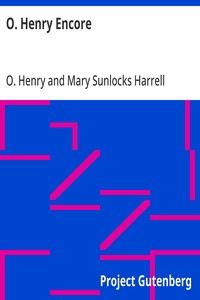
O. Henry Encore — Themes and Context can be approached with a clearer sense of reading commitment from its source measurements: 65,331 words, 4 hr 45 min estimated reading time, and 49 detected text sections.
The text analysis averages about 17.9 words per sentence, while the detected sections provide another way to judge how the source is divided.
Project Gutenberg metadata also associates the work with “Short stories, American,” connecting these edition facts with the source record’s subject description.
Explore this collection
These alternatives are selected using recorded categories and estimated reading time.
About 291 minutes
Adventure Picaresque Fiction
66,924 recorded words. 6 minutes difference from this book's estimate.
View Gutenberg source #24873About 243 minutes
Adventure Picaresque Fiction
55,719 recorded words. 42 minutes difference from this book's estimate.
View Gutenberg source #55408About 234 minutes
Adventure Picaresque Fiction
53,670 recorded words. 51 minutes difference from this book's estimate.
View Gutenberg source #37038Search stored excerpts and compare books → Choose by your preferences →
Choices use stored catalog measurements. Estimates vary with reading speed. A shared category is a catalog label, not a claim that two books have the same argument or literary quality.
Search reads excerpt text stored with this catalog and links to its associated Gutenberg record. The connection is stored in the site database; this tool does not recheck that every excerpt is word-for-word identical to that external record. Excerpt search does not cover every chapter and does not verify historical publication dates.
Catalog snapshot checked: 2026-09-25. Coverage: 92 public books, 92 available source excerpts.
Read the complete public-domain text at its original source.
Read on Project GutenbergThis volume gathers previously uncollected pieces O. Henry wrote for the Houston Post in 1895–1896, unearthed by editor Mary Sunlocks Harrell during research into his Texas years. The material—stories, sketches, and newspaper poetry—shows a writer still refining his signature blend of local color, ironic reversal, and conversational narration. In the excerpt “A New Microbe,” a scientist’s grand discovery is undercut when his wife reveals he has been examining a bucket of Galveston oysters. That pattern—pretension punctured by plain fact—recurs throughout the collection.
Across the excerpts, O. Henry repeatedly sets up a character’s earnest self-importance only to collapse it with a mundane revelation. In “A New Microbe,” the scientist John exults over a “new bacterium” and imagines naming it after his wife, who then points out he has been studying oysters meant for a church supper. The humor depends on the gap between his scientific jargon—“schizomycetic bacteria,” “iso-diametric cells”—and her blunt domestic knowledge. A similar structure appears in “Vereton Villa,” where a Boston teacher’s mission to “carry light” to Texas is undercut by the narrator’s deadpan delivery and the absurdly low salary of $40 a month. These pieces suggest O. Henry was already comfortable using a knowing, slightly mocking narrator to expose folly.
The excerpt from “A New Microbe” moves deliberately from the scientist’s laboratory—a space of locked doors and microscopes—to the domestic realm of church suppers and oyster buckets. The story’s pivot occurs when the wife enters the lab, a place the scientist “generally refused to let her in,” and immediately reinterprets his discovery through household knowledge. This spatial shift from professional to domestic is a recurring device in the collection. In “Vereton Villa,” the narrator travels from Massachusetts to Texas, carrying assumptions about “benighted inhabitants” that the story’s setting will likely challenge. The movement between regions and between public and private spheres gives these short pieces a structural tension that O. Henry exploits for comic and ironic effect.
The editorial preface notes that O. Henry’s newspaper work often appeared under the name “The Post Man,” and the excerpts show a narrator who is both involved and detached. In “Vereton Villa,” the first-person narrator, Penelope, speaks in a prim, self-aware tone: “It is a grand mission to go to Texas and carry what light I can to its benighted inhabitants.” The exaggerated formality clashes with the mundane details that follow, creating a dry humor. In “A New Microbe,” the narrator reports dialogue and action without commentary, letting the wife’s exclamation—“Microbes, indeed!”—deliver the punchline. This variety in narrative distance—sometimes intimate, sometimes observational—suggests O. Henry was testing different voices for the newspaper audience, from the confiding to the sardonic.
The excerpts are set in Texas, and the editor emphasizes that O. Henry’s time in the state shaped his later work. In “A New Microbe,” the bayou water and the church supper evoke a specific, small-town Southern atmosphere. The scientist’s laboratory is a makeshift space, and his wife’s bucket of Galveston oysters ties the story to the Gulf Coast. “Vereton Villa” explicitly addresses regional stereotypes: the narrator expects to find “savage people” but the story’s framing suggests those expectations will be upended. The collection’s table of contents includes titles like “The Mirage on the Frio” and “A Houston Romance,” indicating that many pieces draw on Texas landscapes and communities. These early sketches show O. Henry using place not just as backdrop but as a source of comic contrast between local realities and outsider pretensions.
Readers approaching O. Henry Encore will find a writer in transition, honing the ironic reversals and conversational tone that would later define his famous short stories. The pieces are best read as experiments in structure and voice, often turning on a single, well-placed detail. Pay attention to how O. Henry moves characters between settings—laboratory and kitchen, train and town—and how he lets a mundane object deflate a grand idea. These early works reward a patient eye for the craft beneath the humor.
There’s something tender about watching a writer before he knew his own name—those Houston pieces feel like finding an old photograph of a friend you only met later in life. The same quiet ache for home and time’s passing lingers in Altitude — Reading Companion, though from a different altitude entirely. One collection remembers Texas mornings; the other, the thin air above them. Both keep company with loneliness, gracefully.
Answer a few questions and save a private reflection on this device.