About 190 minutes
Devil tales — A Reader’s Guide
Adventure Picaresque Fiction
43,629 recorded words. 1 minutes difference from this book's estimate.
View Gutenberg source #70436
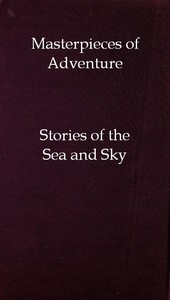
Masterpieces of Adventure—Stories of the Sea and Sky — Reading Notes can be approached with a clearer sense of reading commitment from its source measurements: 43,769 words, 3 hr 11 min estimated reading time, and 4 detected text sections.
The text analysis averages about 19.6 words per sentence, while the detected sections provide another way to judge how the source is divided.
Project Gutenberg metadata also associates the work with “Short stories,” connecting these edition facts with the source record’s subject description.
Explore this collection
These alternatives are selected using recorded categories and estimated reading time.
About 190 minutes
Adventure Picaresque Fiction
43,629 recorded words. 1 minutes difference from this book's estimate.
View Gutenberg source #70436About 203 minutes
Adventure Picaresque Fiction
46,642 recorded words. 12 minutes difference from this book's estimate.
View Gutenberg source #67650About 234 minutes
Adventure Picaresque Fiction
53,670 recorded words. 43 minutes difference from this book's estimate.
View Gutenberg source #37038Search stored excerpts and compare books → Choose by your preferences →
Choices use stored catalog measurements. Estimates vary with reading speed. A shared category is a catalog label, not a claim that two books have the same argument or literary quality.
Search reads excerpt text stored with this catalog and links to its associated Gutenberg record. The connection is stored in the site database; this tool does not recheck that every excerpt is word-for-word identical to that external record. Excerpt search does not cover every chapter and does not verify historical publication dates.
Catalog snapshot checked: 2026-09-25. Coverage: 92 public books, 92 available source excerpts.
Read the complete public-domain text at its original source.
Read on Project GutenbergNella Braddy's 1921 anthology pairs maritime and aerial adventure in a single volume, drawing stories from Frank Norris, W. Clark Russell, and Edgar Allan Poe, among others. The editor's note defines adventure broadly—encompassing not only strange happenings but also love, life, and death—and states that narrative quality, not technical classification, guided selection. The opening story, Norris's The Ship That Saw a Ghost, immediately establishes a tension between official records and hidden truth: Lloyd's agency reports the tramp freighter Glarus as northbound in ballast, yet the narrator reveals she is actually hundreds of miles south under full steam, a deviation that would scandalize the maritime world.
The volume's structure sets two environments in implicit dialogue. The sea stories—Norris's ghost ship, Russell's nightmare of the doldrums, Sienkiewicz's lighthouse keeper, Maupassant's wreck, and Poe's maelstrom—emphasize isolation, helplessness, and the eerie or sublime power of water. The sky stories, by contrast, are modern and mechanized: Swinton's The Kite and Byrne's Superdirigible "Gamma-I" feature aerial warfare with dirigibles, bombs, and searchlights. In Byrne's excerpt, the protagonist Meriwell observes from a dirigible as a railway terminal is reduced to "a ploughed field—a wilderness of stone and earth, of twisted metal and shattered wood." The language of the sky pieces is faster, more violent, and filled with technical commands—"Empty ballast," "Heave on!"—while the sea narratives often dwell on waiting, superstition, and natural forces.
Braddy's editorial note is unusually candid. She acknowledges copyright difficulties as an excuse for omissions and invites readers to believe that is why a favorite story was left out while "one vastly inferior was included." This self-deprecating tone suggests a pragmatic approach to selection. She also asserts the editor's "inalienable right" to plead such difficulties, framing the anthology as a negotiated compromise rather than a definitive canon. The dedication to Blanche Colton Williams, a scholar of the short story, hints at an academic underpinning. The seven stories span the 19th and early 20th centuries, from Poe (1841) to Byrne (1910s), showing a historical range within the adventure genre.
Several excerpts foreground unreliable or contested information. In Norris's story, the narrator withholds the true purpose of his voyage, and Lloyd's official report is a deliberate fiction. In Byrne's sky story, the dirigible's bombing run is described through sensory fragments: "a vast unspeakable noise, a maddened, crashing roar" and "a vast wave of orange flame, like discoloured sheet lightning." The narrative emphasizes what Meriwell sees through glasses and what he feels—"his heart jump to his mouth"—filtering chaos through a single consciousness. Poe's A Descent into the Maelström likewise depends on a survivor's testimony. Across the volume, characters are positioned as witnesses to events that defy easy explanation, and the reader must weigh their accounts against the gaps left untold.
Technology plays a dual role: it enables adventure but also becomes a source of vulnerability. The Glarus has blown a cylinder head and proceeds under sail; the dirigible in Byrne's story shivers "like a feather in a gully of wind" and relies on ballast release, lanyards, and bomb cages. The narrator of Norris's tale notes that a ship cannot "quibble without suspicion," personifying the vessel as subject to moral judgment. In the sky story, the anti-aircraft guns and searchlights are antagonists with animal tenacity—"the searchlight caught them again and hung on with the tenacity of a bulldog." The human operators are reduced to reactive roles: Meriwell opens his mouth mechanically to protect his eardrums. The machinery does not liberate; it intensifies danger.
Readers approaching this collection should attend to the contrasts between its two halves: the slow, atmospheric dread of the sea tales versus the rapid, technical terror of the sky stories. Braddy's selection rewards attention to narrative voice—each story employs a distinct frame, from confidential confession to omniscient reportage. The volume does not offer a unified theory of adventure but rather a set of variations on risk, perception, and the limits of human control. Treat each story as an independent experiment in how suspense is built and broken.
That rainy afternoon, the anthology’s ghostly tramp steamer lingered longer than the dirigibles, a quiet ache for vastness that I couldn’t shake. Later, tracing that same loneliness northward, I found myself lost in Arctic angels — Background and Themes—not a search, just a drift. The cold felt familiar, like the sea’s fog had simply frozen, and I stayed there for hours.
Your answers remain private and are stored only in this browser.