
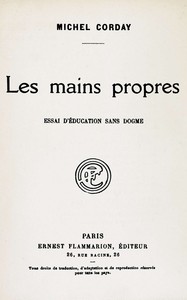
Les mains propres : Essai d'éducation sans dogme by Michel Corday
Published in 1913, Les mains propres (Clean Hands) is Michel Corday's quiet manifesto against the heavy-handed, moralistic education of his time. Corday was a novelist and essayist, not a professional educator, which gives his perspective a refreshingly direct and human quality. He wrote this as a parent, for parents, questioning the very foundations of how society shapes its young.
The Story
There isn't a traditional narrative here. Instead, Corday builds his case like a thoughtful conversation. He paints a picture of the standard education of the era: full of rigid rules, enforced discipline, and a focus on stamping out a child's natural impulses to create 'proper' citizens. Against this, he proposes an alternative. The 'clean hands' of the title is a metaphor. It means educators and parents should refrain from imposing their own prejudices, political beliefs, and rigid moral codes onto children. He argues for observation, patience, and trust in a child's innate capacity to develop reason and character if given a healthy environment and freedom from dogma. The 'essay' walks you through his reasoning, challenging each piece of conventional wisdom about obedience, punishment, and the adult's 'right' to mold young minds.
Why You Should Read It
What struck me most was how current it feels. Over a century later, we're still having the same debates about homework, standardized testing, screen time, and how much freedom is too much. Reading Corday is like finding a clear, calm voice in a very noisy room. His core idea—that relentless adult intervention might actually hinder a child's growth—is both simple and profound. It’s not about permissiveness; it's about respect. He asks us to have the humility to question our own certainty about what's 'best' for a child. While some of his specific references are dated, the central plea for critical thinking in how we raise the next generation is timeless. It made me rethink not just education, but how we interact with anyone we have influence over.
Final Verdict
This book is a hidden gem for anyone interested in the history of parenting ideas, progressive education, or just good, challenging non-fiction. It's perfect for parents or teachers feeling burned out by today's pressure-cooker advice culture, offering a historical perspective that's oddly liberating. It's also a great, short read for fans of thinkers like John Dewey or Maria Montessori, showing these ideas had roots in other parts of the world. Fair warning: it's an essay of ideas, not a story. But if you're in the mood for something that will make you nod, underline passages, and think, 'He wrote this in 1913?!' then pick it up. It's a quiet book with a loud message that still resonates.
This title is part of the public domain archive. Feel free to use it for personal or commercial purposes.
Barbara White
1 year agoGreat reference material for my coursework.
John Lopez
1 year agoI came across this while browsing and the author's voice is distinct and makes complex topics easy to digest. Truly inspiring.
Amanda Miller
5 months agoI was skeptical at first, but the narrative structure is incredibly compelling. Thanks for sharing this review.
Noah Hernandez
2 years agoIf you enjoy this genre, the arguments are well-supported by credible references. I would gladly recommend this title.

Emily Hernandez
1 year agoI was skeptical at first, but it creates a vivid world that you simply do not want to leave. Highly recommended.