About 45 minutes
The curse of Yig — Background and Themes
Science Fiction Utopias
10,142 recorded words. 1 minutes difference from this book's estimate.
View Gutenberg source #70912
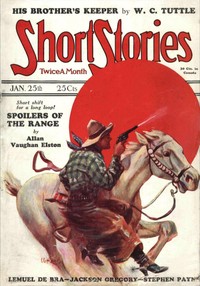
His brother's keeper — Inside the Classic can be approached with a clearer sense of reading commitment from its source measurements: 10,018 words, 44 min estimated reading time, and 2 detected text sections.
The text analysis averages about 14.2 words per sentence, while the detected sections provide another way to judge how the source is divided.
Project Gutenberg metadata also associates the work with “Short stories,” connecting these edition facts with the source record’s subject description.
Explore this collection
These alternatives are selected using recorded categories and estimated reading time.
About 45 minutes
Science Fiction Utopias
10,142 recorded words. 1 minutes difference from this book's estimate.
View Gutenberg source #70912About 37 minutes
Science Fiction Utopias
8,394 recorded words. 7 minutes difference from this book's estimate.
View Gutenberg source #75097About 36 minutes
Science Fiction Utopias
8,085 recorded words. 8 minutes difference from this book's estimate.
View Gutenberg source #73556Search stored excerpts and compare books → Choose by your preferences →
Choices use stored catalog measurements. Estimates vary with reading speed. A shared category is a catalog label, not a claim that two books have the same argument or literary quality.
Search reads excerpt text stored with this catalog and links to its associated Gutenberg record. The connection is stored in the site database; this tool does not recheck that every excerpt is word-for-word identical to that external record. Excerpt search does not cover every chapter and does not verify historical publication dates.
Catalog snapshot checked: 2026-09-25. Coverage: 92 public books, 92 available source excerpts.
Read the complete public-domain text at its original source.
Read on Project GutenbergThe story opens with a striking image of the Bitter Water Valley: 'the hills were like rumpled yellow and gray blankets, shimmering in the summer sun.' This harsh setting immediately establishes a world where even the wind is hot, and folks 'simply charred.' The first scene shows Mrs. Deming fleeing with deputy Joe Mills, who admits he 'seen it comin'' and expects to be fired by her husband, Sheriff Jim Deming. The sheriff's reputation for hardness is established early—Joe Mills, 'as hard as the lava beds,' found a man harder than he. The opening thus sets up a conflict between personal loyalty and the sheriff's unbending sense of duty.
The excerpts repeatedly emphasize Sheriff Deming's inflexibility. Joe Mills describes him as 'bull-headed as hell' and notes that 'yuh can't tell him nothin'.' Mrs. Deming reveals that her husband sent her son to prison, a decision that has driven her to leave. The narrator states that Deming 'was so hard that he rather appalled even Joe Mills.' This characterization is not merely told but shown through dialogue: when the sheriff later wakes in Red Cowan's cabin, he immediately thinks of his duty to capture Cowan, even while delirious with smallpox. The cost of this hardness is personal isolation—his wife leaves, his deputy quits, and he ends up dependent on the very man he hunts.
A central irony emerges when the sheriff, having set out to arrest Red Cowan, becomes the one who needs care. Cowan finds him delirious in the lava beds and nurses him for three days. The sheriff, upon learning his rescuer's identity, lies about why he was there: 'Cowan must not know why he was out there.' Yet Cowan, recognizing the sheriff's star, treats him with a rough kindness. When smallpox appears, Cowan decides to fetch a doctor, despite the risk. The sheriff's dilemma is clear: he needs Cowan's help but also wants to take him prisoner. This reversal forces the reader to reconsider who is the 'keeper' in this brotherhood.
The disease is not merely a complication but a catalyst for moral choices. The sheriff, upon seeing the rash, whispers 'Smallpox!' and fears Cowan will abandon him. Yet Cowan, who has had the disease, stays and even ties the sheriff down to prevent him from wandering. The sheriff's delirium causes him to 'babble of murderers, horse thieves and of his own prowess as a sheriff,' revealing his obsession with his reputation. Cowan's response—'Lucky I've had a good dose of it'—shows a pragmatic decency. The illness strips away the sheriff's authority, leaving him vulnerable and forcing him to rely on the outlaw's mercy.
Tuttle's dialogue is terse and idiomatic, distinguishing characters instantly. Mrs. Deming speaks with resignation: 'I had to do it, Joe. I just had to.' Joe Mills replies with a slow, dry drawl: 'I know it, Mrs. Deming. I seen it comin'.' The sheriff's voice, when weak, surprises him: 'he was surprised that his voice was so weak.' Red Cowan's speech is more direct and colloquial: 'You shore know how to be sick,' he grins. These vocal tics—the clipped sentences, the repeated 'yuh' and 'shore'—create a sense of place and personality. The dialogue carries the story's emotional weight, from Mrs. Deming's grief to Cowan's weary humor.
Readers should note that the excerpts end before the story's resolution, leaving key questions open: Will the sheriff recover? Will he arrest Cowan after being saved by him? The title 'His Brother's Keeper' hints at a moral reckoning, but the text provided does not reveal the outcome. Pay attention to how Tuttle uses the desert setting and the smallpox crisis to test the characters' definitions of duty and humanity. The story's brevity (about 10,000 words) suggests a tight narrative where every scene counts.
I remember once, bedridden with fever, how a stranger’s kindness felt almost unbearable—like I owed something I couldn’t repay. Cowan’s quiet care for Sheriff Deming stirred that same unease. It reminded me of a gentle story in Lucy Maud Montgomery Short Stories, 1904 — Context and Discussion, where duty softens into something more human, neither hero nor villain, just two people caught in circumstance.
Save your reaction, strongest insight, and memorable passage.