About 29 minutes
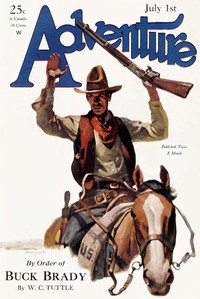
By order of Buck Brady — Themes and Context
Historical Psychological Social Fiction
6,455 recorded words. 3 minutes difference from this book's estimate.
View Gutenberg source #73555
The source record for Empty bottles — Story, Setting & Ideas measures this digital text at 5,856 words, 26 min estimated reading time, and 1 detected text section.
The text analysis averages about 15.7 words per sentence, while the detected sections provide another way to judge how the source is divided.
Project Gutenberg metadata also associates the work with “Short stories,” connecting these edition facts with the source record’s subject description.
Explore this collection
These alternatives are selected using recorded categories and estimated reading time.
About 29 minutes
Historical Psychological Social Fiction
6,455 recorded words. 3 minutes difference from this book's estimate.
View Gutenberg source #73555About 33 minutes
Historical Psychological Social Fiction
7,523 recorded words. 7 minutes difference from this book's estimate.
View Gutenberg source #75758About 40 minutes
Historical Psychological Social Fiction
8,993 recorded words. 14 minutes difference from this book's estimate.
View Gutenberg source #76811Search stored excerpts and compare books → Choose by your preferences →
Choices use stored catalog measurements. Estimates vary with reading speed. A shared category is a catalog label, not a claim that two books have the same argument or literary quality.
Search reads excerpt text stored with this catalog and links to its associated Gutenberg record. The connection is stored in the site database; this tool does not recheck that every excerpt is word-for-word identical to that external record. Excerpt search does not cover every chapter and does not verify historical publication dates.
Catalog snapshot checked: 2026-09-25. Coverage: 92 public books, 92 available source excerpts.
Read the complete public-domain text at its original source.
Read on Project GutenbergThe story opens in the One Way Thru Saloon, where a large, awkward man asks for an empty quart bottle—not, as the regulars assume, a bottle of liquor. The bartender, Cock Eye Baer, quips that what the man really needs is a nipple for the bottle, a joke that gets retold and embellished throughout the narrative. This initial scene establishes a pattern: the saloon as a stage for verbal performance, where a single remark can become a local legend.
The story's structure hinges on repeated returns to the saloon. After the stranger leaves with his empty bottle, the crowd recounts Cock Eye's joke, and the telling itself becomes a ritual: “none of the explainers had exactly the lingo and tang” to match the original. Later, the same joke is recalled again after Cock Eye's death, with a patron vowing never to forget it. This repetition underscores how the saloon functions as a space where stories are not just told but performed and preserved.
The narrative moves between the saloon's interior and the broader camp. The stranger goes “down the street” after getting the bottle, and later Cock Eye encounters him on Butte Street. These shifts are brief but significant: they contrast the contained, laughter-filled bar with the practical, everyday world outside. The bottle itself—meant for a baby's stomach ache—bridges these spaces, transforming a barroom joke into a domestic necessity.
Bottles appear throughout as objects of negotiation. The stranger rinses two bottles, one white and one brown, smelling of whisky. The bartender's joke plays on the expectation that a bottle should contain liquor. Even in death, the final toast is “Here's how, old boy!”—a drink raised to Cock Eye. The empty bottle becomes a symbol of absence and potential, while full bottles mark conviviality and remembrance.
The dialogue captures a specific Western vernacular. Characters speak in clipped phrases (“I want a bottle!”), with repetitions and hesitations (“I don’t know’f I thanked ye”). Cock Eye's wit is described as having a particular “lingo and tang” that others cannot replicate. The story's humor depends on oral delivery—the way a line is said matters as much as its content. This attention to speech patterns gives the barroom exchanges a distinctive, lived-in quality.
Readers attentive to the story's structure will notice how each return to the saloon layers new meaning onto the initial joke. The bottle, the bar, and the bartender form a tight constellation of images that the narrative circles around. Pay particular attention to the shifts in setting and the way characters retell events—these repetitions are not filler but the story's central mechanism for building character and community.
That stranger with his empty bottle—it reminds me of my uncle, who’d trade a joke for a refill at any bar we passed. Cock Eye Baer’s quiet wit felt like a handshake across years. Tales from Two Hemispheres — Background and Themes gave me that same warm ache, the way a story can hold a whole life in a single glance.
Save your reaction, strongest insight, and memorable passage.









