About 26 minutes
Empty bottles — Story, Setting & Ideas
Historical Psychological Social Fiction
5,856 recorded words. 3 minutes difference from this book's estimate.
View Gutenberg source #73941
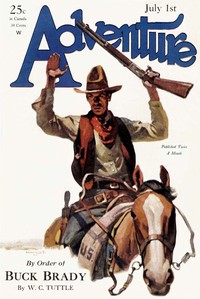
Before opening By order of Buck Brady — Themes and Context, the edition data offers a quick orientation: 6,455 words, 29 min estimated reading time, and 1 detected text section.
The text analysis averages about 16.1 words per sentence, while the detected sections provide another way to judge how the source is divided.
Project Gutenberg metadata also associates the work with “Short stories,” connecting these edition facts with the source record’s subject description.
Explore this collection
These alternatives are selected using recorded categories and estimated reading time.
About 26 minutes
Historical Psychological Social Fiction
5,856 recorded words. 3 minutes difference from this book's estimate.
View Gutenberg source #73941About 33 minutes
Historical Psychological Social Fiction
7,523 recorded words. 4 minutes difference from this book's estimate.
View Gutenberg source #75758About 40 minutes
Historical Psychological Social Fiction
8,993 recorded words. 11 minutes difference from this book's estimate.
View Gutenberg source #76811Search stored excerpts and compare books → Choose by your preferences →
Choices use stored catalog measurements. Estimates vary with reading speed. A shared category is a catalog label, not a claim that two books have the same argument or literary quality.
Search reads excerpt text stored with this catalog and links to its associated Gutenberg record. The connection is stored in the site database; this tool does not recheck that every excerpt is word-for-word identical to that external record. Excerpt search does not cover every chapter and does not verify historical publication dates.
Catalog snapshot checked: 2026-09-25. Coverage: 92 public books, 92 available source excerpts.
Read the complete public-domain text at its original source.
Read on Project GutenbergThe story opens with a striking image: Sheriff Buck Brady, tilted back in a broken chair, endlessly whittling soft pine into thin shavings. His town, Mojave Wells, is a heat- and sand-scoured place where painted signs have been blasted unreadable. This unhurried, almost absurd habit becomes the story's central metaphor for a lawman who works not by force but by patient, quiet intervention.
From the first pages, the narrative voice is lean and laconic, matching the sheriff's drawl. Ben Dolan rides in early to warn Buck that a feud between Bud Hickman and Pete Asher over Rosie Smith will erupt that night. Buck listens, cuts a long shaving, and says only, "You might tell me the rest." The reader is set up for a showdown—but the sheriff has a plan that depends on being underestimated.
Buck Brady's whittling is not mere color; it is a deliberate performance of harmlessness. The narrator tells us that "thin shavings were an obsession with Buck," and he whittles even as Ben describes the coming violence. When Ben finishes, Buck "cut a particularly long shaving, looked at it critically and nodded with satisfaction." This repeated action signals that Buck processes information through his hands, and that his apparent distraction is actually focus.
The whittling also serves as a social prop. It allows Buck to seem unthreatening, so that cowboys speak freely in front of him. When Ben explains the feud, Buck's minimal responses—"Uh-huh," "Yea-a-ah"—encourage Ben to keep talking. The reader learns early that Buck's passivity is strategic. He is gathering intelligence while appearing to do nothing.
The feud is sketched with economical detail. Ben reports that Bud Hickman and Pete Asher have been "shinin' around" Rosie Smith, and that a remark about a picket fence triggered the conflict. The narrator never describes Rosie directly; she exists only as a cause. The cowboys themselves are defined by their factions: Bud's gang and Pete's gang, both planning to "imbibe real freely."
This minimalism is typical of W. C. Tuttle's style. The setting—Road Runner Valley, a place of sand and heat—is evoked in a few strokes. The dialogue carries the plot. Ben's warning that "it'll be kinda wooly around here t'night" is all the atmosphere the story needs. The reader must infer the tension from what is left unsaid, much as Buck does.
The climax arrives when Bud and Pete face off, only to discover their guns are loaded with powderless shells. Buck reveals he pulled the bullets. This is not a dramatic arrest but a quiet humiliation. The sheriff tells them, "I don't reckon either of you showed any yaller streak. You played the game square." He reframes the confrontation as a test they both passed.
Buck's final revelation—that he married Rosie Smith a week ago—is delivered with the same calm as his whittling. Bud's stunned question, "Whittlin'?" after Buck says he has work to do, ties the ending back to the opening image. The sheriff's method has been consistent: he defuses conflict by removing its ammunition, literally and figuratively.
The excerpts do not show Rosie Smith's perspective, nor do they reveal whether she chose Buck freely. The story's brevity (6,455 words) means many details are implied rather than stated. For instance, Ben's role as informant suggests a community that tolerates the sheriff's unorthodox methods. The cowboys' quick surrender of their guns indicates that Buck's authority is accepted, even when his trick is exposed.
Readers should note that the excerpts cut off before the full resolution. The final line, "THE END," appears after Buck's announcement, but the text does not show the cowboys' reaction or the aftermath. This leaves room for interpretation: is Buck's marriage a happy ending, or a cynical move to end the feud? The story trusts the reader to fill in the emotional gaps.
This story rewards attention to small details: the sand-blasted signs, the weary roan horse, the way Buck "squinted at his handiwork." Tuttle's prose is spare but precise, and the sheriff's whittling is a clue to his character from the first sentence. As you read, watch how Buck's stillness controls the action, and consider what the story leaves out—especially Rosie Smith's voice. The gaps are as telling as the words.
There’s a particular stillness in Sheriff Brady’s whittling—how he shapes a quiet end to violence without ever raising his voice. It reminds me of how Crusoe in New York, and other tales — Reading Notes charts solitude, not as escape, but as a patient, hand-carved form of belonging. Both leave me feeling the calm weight of a story that solves itself in near silence.
Save your reaction, strongest insight, and memorable passage.









