
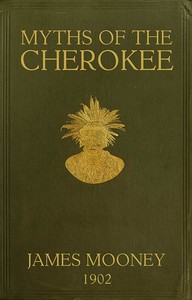
Myths of the Cherokee by James Mooney
Let's clear something up first: this isn't a storybook with chapters that follow a single hero. Instead, it's a vital record. In the 1880s and 90s, James Mooney of the Smithsonian Institution spent years living with the Eastern Band of Cherokee in North Carolina. His mission was to document their culture with a respect that was rare for his time. This book is the stunning result.
The Story
The 'plot' is the history of the world according to Cherokee tradition. It starts at the very beginning, with stories of how the earth was created on the back of a great turtle swimming in a primordial sea. You'll meet the powerful, sometimes mischievous, animal people who shaped the mountains and rivers. Then come the epic tales of the first humans, their struggles, and their interactions with the spirit world. The book also includes sacred formulas, descriptions of rituals, and historical narratives. It's a full spectrum of belief, from why the possum's tail is bare to the profound spiritual principles that guided a nation.
Why You Should Read It
Reading this feels like being granted special access. You're not getting a watered-down, romanticized version of Native myths. You're getting the real thing, as told by the people themselves to a committed listener. The themes are universal—creation, curiosity, consequence, and the bond between humans and nature—but the perspective is uniquely Cherokee. I was completely drawn in by the cleverness of the characters, like Rabbit, who is always scheming, and the sheer scale of the imagination on display. It makes you see the landscape differently. Every mountain and stream in their homeland has a story, and this book is the map.
Final Verdict
This book is perfect for anyone with a curiosity about American history that goes deeper than textbooks. It's for fans of mythology from any culture, for people who love folklore and wonder where local legends come from, and for anyone who believes a place is defined by its oldest stories. It's not a light read—it's a rich, dense collection to savor—but it is a profoundly rewarding one. Think of it less as a book you simply read, and more as one you visit and learn from, time and again.
This book is widely considered to be in the public domain. You are welcome to share this with anyone.
Ashley Robinson
1 year agoA must-have for anyone studying this subject.
Michael Wilson
1 year agoI stumbled upon this title and it challenges the reader's perspective in an intellectual way. Thanks for sharing this review.
Liam Hernandez
2 years agoTo be perfectly clear, the character development leaves a lasting impact. One of the best books I've read this year.
Susan White
1 year agoI was skeptical at first, but the character development leaves a lasting impact. I would gladly recommend this title.

Jackson Robinson
9 months agoAs someone who reads a lot, the clarity of the writing makes this accessible. A valuable addition to my collection.