About 368 minutes
Short Stories — Edition Insights
Historical Psychological Social Fiction
84,572 recorded words. 3 minutes difference from this book's estimate.
View Gutenberg source #40745
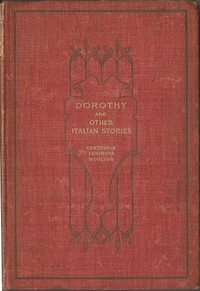
Dorothy, and Other Italian Stories — Themes and Context can be approached with a clearer sense of reading commitment from its source measurements: 85,231 words, 6 hr 11 min estimated reading time, and 8 detected text sections.
The text analysis averages about 15.0 words per sentence, while the detected sections provide another way to judge how the source is divided.
Project Gutenberg metadata also associates the work with “Short stories, American,” connecting these edition facts with the source record’s subject description.
Explore this collection
These alternatives are selected using recorded categories and estimated reading time.
About 368 minutes
Historical Psychological Social Fiction
84,572 recorded words. 3 minutes difference from this book's estimate.
View Gutenberg source #40745About 376 minutes
Historical Psychological Social Fiction
86,401 recorded words. 5 minutes difference from this book's estimate.
View Gutenberg source #1716About 366 minutes
Historical Psychological Social Fiction
84,041 recorded words. 5 minutes difference from this book's estimate.
View Gutenberg source #1725Search stored excerpts and compare books → Choose by your preferences →
Choices use stored catalog measurements. Estimates vary with reading speed. A shared category is a catalog label, not a claim that two books have the same argument or literary quality.
Search reads excerpt text stored with this catalog and links to its associated Gutenberg record. The connection is stored in the site database; this tool does not recheck that every excerpt is word-for-word identical to that external record. Excerpt search does not cover every chapter and does not verify historical publication dates.
Catalog snapshot checked: 2026-09-25. Coverage: 92 public books, 92 available source excerpts.
Read the complete public-domain text at its original source.
Read on Project GutenbergThe first story, 'Dorothy,' opens on a Saturday at the Villa Dorio, a hilltop above Florence's Roman Gate. The narrator swiftly establishes a social taxonomy: visitors divide between garden and salon, young people and old, contented husbands and well-trained ones. The gardener Giuseppe doubles as footman, and the view from Bellosguardo is 'fair indeed.' This precise, ironic social mapping—paired with a setting that is both real and symbolic—characterizes Woolson's method throughout the collection.
The excerpt then moves to a tense interior scene. Margaret, a young American, confesses to a man that she has tried to 'become interested in him' as a cure for loving another. Her language is clinical: 'acquired interest,' 'studied you,' 'tried to believe in you.' The dialogue is taut, with each line advancing a psychological standoff. Woolson's voice is cool, analytical, yet capable of sudden emotional pressure—as when Margaret's hands are 'reddened with their pressure against each other.'
The opening pages of 'Dorothy' establish a world where every gesture is legible. Giuseppe's role—gardener by week, footman on Saturdays—signals a permeable boundary between service and society. The visitors sort themselves by inclination: the young and the men who 'like to appear young' head to the garden; old ladies and those who 'detest gardens' climb to the salon. Woolson itemizes these choices with a dry, almost taxonomic precision. The hill itself, Bellosguardo, is named for its 'fair outlook,' but the narrator notes that Mrs. Tracy has 'escaped' from the western view. This small detail hints at a pattern: characters are often in flight from beauty or from each other. The villa is not merely a backdrop but an active social machine, sorting its inhabitants into visible hierarchies.
Margaret's confession to her interlocutor is striking for its deliberate, almost scientific language. She speaks of 'acquired interest' and compares it to learning to care for 'music, in pictures, in sports.' The word 'experiment' appears in the story's title, 'A Florentine Experiment,' and the method is laid bare: she has 'studied' him, 'tried to find the good,' 'tried to idealize.' The man responds with a skeptical question: 'A remedy may be worse than a disease.' Woolson gives each character a distinct rhetorical stance—Margaret's passionate logic versus his cool irony. The dialogue is a duel of self-awareness, where each party tries to define the other's motives. Notably, Margaret insists her tears are not for him, but for 'some one else.' The emotional geometry is triangular, but the narrator refuses to simplify it into melodrama.
Throughout the excerpt, Woolson uses physical details to convey psychological states. Margaret's hands are 'pressed so tightly together' that the man can see 'the force of the pressure.' Later, she 'unlocks her hands, reddened with their pressure.' This image of self-restraint—of hands clenched to the point of pain—echoes the larger theme of emotional control. The man 'touches her hand,' but she 'draws it from him.' Touch is offered and refused. The setting itself reinforces this: the villa's open doors and garden paths suggest freedom, but the characters are locked in private negotiations. Even the dog, mentioned in the illustration list, appears 'at the extreme length of his cord.' Restraint, whether self-imposed or external, is a quiet constant.
The provided text cuts off before the story's resolution. We do not learn whether Margaret's experiment succeeds or fails, nor how the man's attachment to Beatrice—'the loveliest woman in the world'—develops. The title story's full arc remains unknown. However, the other titles in the collection—'A Transplanted Boy,' 'A Florentine Experiment,' 'A Waitress,' 'At the Château of Corinne'—suggest a recurring interest in displacement and social roles. The excerpts offer no evidence of a unified plot across stories. Readers should approach each tale as an independent study, alert to Woolson's habit of withholding easy conclusions. The emotional temperature is cool, but the pressure is real.
Woolson's stories reward attention to small gestures—a hand pressed too tightly, a gardener's dual role, a view that one character avoids. The excerpts suggest a writer more interested in the architecture of feeling than in dramatic incident. As you read, note how each story establishes its own social rules and then tests them through dialogue. The Italian settings are not picturesque backdrops but active forces that shape what can be said and felt. Let the precision of Woolson's observation guide you; the emotional truths here are earned, not declared.
Reading Woolson's Dorothy again, I felt that old ache of watching someone rehearse feelings like lines from a script. The villa's sunlight seemed almost cruel. It reminded me of an earlier book, Pencil Sketches; or, Outlines of Character and Manners — Key Ideas to Explore, which catches people in their quiet poses too. Both feel like letters from a forgotten time, patient and true.
A brief reflection can help important ideas stay with you longer.









