About 372 minutes
Taking Chances — Story, Setting & Ideas
Fantasy Juvenile Worlds
85,500 recorded words. 14 minutes difference from this book's estimate.
View Gutenberg source #37477
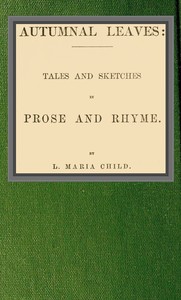
The source record for Autumnal leaves: tales and sketches in prose and rhyme — Themes and Context measures this digital text at 88,741 words, 6 hr 26 min estimated reading time, and 10 detected text sections.
The text analysis averages about 20.0 words per sentence, while the detected sections provide another way to judge how the source is divided.
Project Gutenberg metadata also associates the work with “Short stories, American,” connecting these edition facts with the source record’s subject description.
Explore this collection
These alternatives are selected using recorded categories and estimated reading time.
About 372 minutes
Fantasy Juvenile Worlds
85,500 recorded words. 14 minutes difference from this book's estimate.
View Gutenberg source #37477About 340 minutes
Fantasy Juvenile Worlds
78,132 recorded words. 46 minutes difference from this book's estimate.
View Gutenberg source #54676About 337 minutes
Fantasy Juvenile Worlds
77,463 recorded words. 49 minutes difference from this book's estimate.
View Gutenberg source #26475Search stored excerpts and compare books → Choose by your preferences →
Choices use stored catalog measurements. Estimates vary with reading speed. A shared category is a catalog label, not a claim that two books have the same argument or literary quality.
Search reads excerpt text stored with this catalog and links to its associated Gutenberg record. The connection is stored in the site database; this tool does not recheck that every excerpt is word-for-word identical to that external record. Excerpt search does not cover every chapter and does not verify historical publication dates.
Catalog snapshot checked: 2026-09-25. Coverage: 92 public books, 92 available source excerpts.
Read the complete public-domain text at its original source.
Read on Project GutenbergLydia Maria Child's Autumnal Leaves (1856) gathers tales, sketches, and poems originally published over a decade earlier, alongside newer pieces written in spare hours. The collection's title suggests a retrospective mood, yet the contents range from a love story set in the Far West to a dialogue between a Catholic and a Quaker, and from a poem about Kansas emigrants to an essay on animal intelligence. The catalog subjects—short stories, American fiction, and essays—accurately reflect the generic mix, but the excerpts reveal a stronger reformist thread than those labels imply, particularly around gender roles and class hierarchy.
The opening story, 'The Eglantine,' immediately challenges the catalog's neutral 'short stories' classification. A wealthy mother and daughter discuss a pretty nursery maid, predicting her beauty will lead to ruin with a 'dissipated lord' and eventual marriage to a 'good-natured clown.' The daughter, Julia, glances at a mirror and thinks a duke might be won with such looks. Child uses this dialogue to expose class prejudice: the aristocratic women assume the servant's beauty is wasted on her station, while their own vanity is unchecked. The story's subtitle—'A simple Love Story, founded on a romantic incident'—belies its pointed social critique. The excerpt shows Child embedding reformist commentary within conventional romance, a pattern that recurs throughout the volume.
'The Brother and Sister' centers on Esther, who sacrifices her own education and health to support her brother John's rise from poverty to a secretaryship in Spain. Child repeatedly raises the question, 'Why cannot women go abroad, and earn their own way in the world, as well as men?'—a direct challenge to the era's gender norms. The story traces John's growing awareness of Esther's intellect, yet she remains confined to domestic labor while he travels. The narrator notes that 'the coming ages answered him, but he did not hear the prophecy,' signaling Child's forward-looking perspective. This piece, like others in the collection, uses sibling bonds to explore systemic inequality, blending sentimental narrative with proto-feminist argument.
The catalog lists 'American essays' and 'poetry' as secondary topics, but the excerpts show reformist concerns cutting across genres. 'The Catholic and the Quaker' stages a religious dialogue, while 'The Kansas Emigrants' addresses westward expansion. Even the poem 'I Want to Go Home' likely touches on displacement. Child's preface notes that several pieces appeared in periodicals a decade earlier, suggesting she revised them for this volume. The variety—from the sentimental 'The Eglantine' to the didactic 'Intelligence of Animals'—indicates a writer using multiple forms to advance moral and social arguments. Readers should expect not a unified narrative but a mosaic of reformist fiction, essay, and verse, each piece refracting Child's concerns through a different generic lens.
Child's Autumnal Leaves rewards readers who attend to the interplay between its genres and its reformist impulses. The catalog subjects understate the collection's critical edge; the excerpts show a writer consistently questioning class privilege and gender constraints. Approach each piece as a discrete argument, noting how Child adapts sentimental, comic, or didactic modes to her purposes. The volume's structure—alternating fiction, essay, and verse—invites comparison across forms, revealing a coherent moral vision beneath the generic variety.
I keep thinking about how Lydia Maria Child’s gentle stories hold sorrow without ever letting it harden. There’s a quiet ache in Autumnal Leaves, especially in the domestic scenes where kindness feels fragile. That same lingering warmth found me again in the mist-covered pages of The land beyond the mist — Background and Themes, where distance and longing feel almost like old friends. Some books simply stay beside you, softly, like autumn light.
Answer a few questions and save a private reflection on this device.


![Cover of Some Short Stories [by Henry James] — Inside the Classic](https://cuiep.com/storage/media/covers/pg2327.jpg)






